
MSME 45-Day Payment Rule: Why Delayed Vendor Payments Are Now a Tax Problem
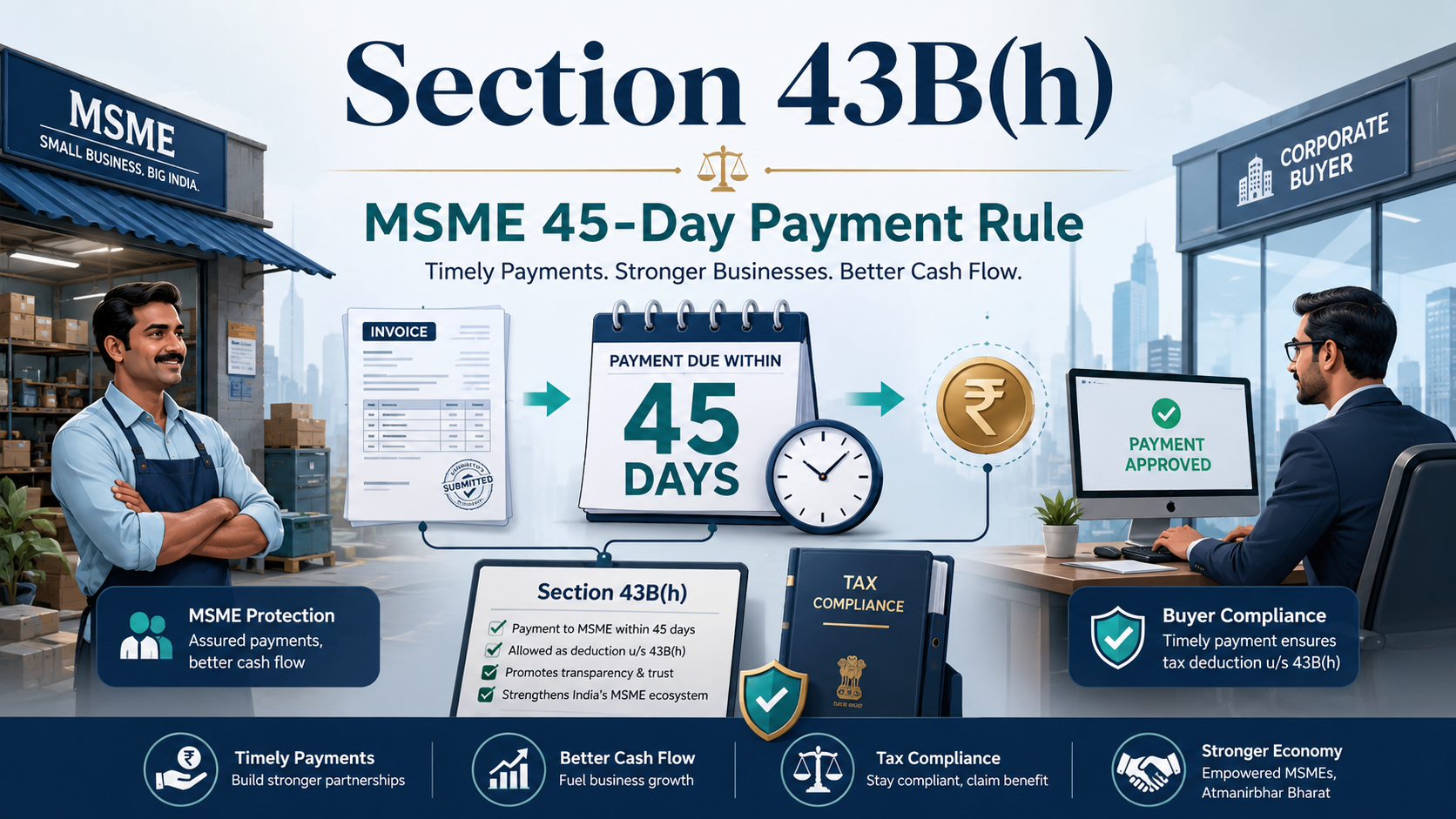
For years, delayed payments to small suppliers were treated as a routine business inconvenience. A large buyer could stretch a payment cycle, preserve its own cash flow, and leave a smaller vendor waiting. The vendor absorbed the pressure. The buyer moved on.
Section 43B(h) changes that equation.
With this provision, the law does not merely ask businesses to pay Micro and Small Enterprises on time. It makes delayed payment expensive in a very specific way: if a buyer does not pay within the prescribed timeline, the expense may not be allowed as a tax deduction in that year. In simple terms, an unpaid invoice to an eligible MSME can now affect taxable income.
This makes the MSME 45-day payment rule more than a compliance update. It is a working-capital discipline, a vendor-management issue, a tax-planning concern, and a boardroom conversation.
What Is Section 43B(h)?
Section 43B(h) was introduced through the Finance Act, 2023 and applies from April 1, 2024, relevant from Assessment Year 2024–25 onwards.
It provides that any sum payable to a Micro or Small Enterprise will be allowed as a deduction only when it is actually paid, if the payment is not made within the time limit prescribed under Section 15 of the MSMED Act, 2006.
The key idea is straightforward: a business cannot claim the benefit of an expense while keeping a small supplier unpaid beyond the legally permitted period.
The Rule in Plain English
When a business buys goods or services from a registered Micro or Small Enterprise, it must pay within:
| Situation | Payment Deadline |
|---|---|
| No written agreement | Within 15 days |
| Written agreement exists | As per the agreement, but not beyond 45 days |
The 45-day period is the outer limit. Even if two parties agree to a 60-day or 90-day credit cycle, that extended timeline will not override the MSMED Act for the purpose of Section 43B(h).
If the buyer misses the applicable deadline, the expense is not deductible in that financial year. The deduction is shifted to the year in which the payment is actually made.
Why the Government Introduced This Rule
The rule addresses one of the biggest hidden problems in the MSME ecosystem: cash-flow starvation.
Many small businesses are profitable on paper but struggle because receivables remain blocked. Salaries, rent, raw materials, GST obligations, loan repayments, and daily operating costs do not wait for a large customer’s payment cycle.
A delayed invoice for a large company may be a treasury tactic. For a small supplier, it can be the difference between survival and shutdown.
Section 43B(h) attempts to correct this imbalance by creating tax consequences for the buyer. It gives Micro and Small Enterprises stronger leverage and pushes larger businesses to treat payment timelines as a compliance obligation rather than a negotiable courtesy.
Who Is Covered?
Section 43B(h) applies when the supplier is a Micro or Small Enterprise registered under the MSMED Act.
The buyer does not need to be registered as an MSME. The focus is on the status of the supplier.
This means a company, partnership firm, LLP, proprietorship, or any business purchasing from a registered Micro or Small Enterprise may need to comply with this rule.
However, the provision is generally understood to apply to Micro and Small Enterprises engaged in manufacturing or providing services. Wholesale and retail traders registered on Udyam for limited purposes, such as priority sector lending benefits, are not treated in the same way for Section 43B(h) benefits.
Updated MSME Classification Limits
A supplier’s MSME status depends on investment and turnover. The classification framework was revised to give businesses more room to grow while retaining MSME benefits.
| Enterprise Category | Investment Limit | Turnover Limit |
|---|---|---|
| Micro Enterprise | Up to ₹2.5 crore | Up to ₹10 crore |
| Small Enterprise | Up to ₹25 crore | Up to ₹100 crore |
| Medium Enterprise | Up to ₹125 crore | Up to ₹500 crore |
Section 43B(h), however, is especially relevant for payments to Micro and Small Enterprises. Medium enterprises are not covered for this specific disallowance mechanism.
What Happens If Payment Is Delayed?
The consequence is not that the expense disappears forever. Instead, the deduction is postponed.
Suppose a business purchases services worth ₹5,00,000 from a registered Micro Enterprise. The payment is due within 45 days, but the buyer pays after the deadline and after the close of the financial year.
In that case, the buyer may not be able to claim the ₹5,00,000 expense as a deduction in the year in which it was booked. The deduction will be allowed only in the financial year in which the payment is actually made.
This can increase taxable income for the year of default and create an unexpected tax outflow.
A Simple Example
Imagine a company receives goods from a registered Small Enterprise on February 20, 2026. There is a written agreement allowing 45 days of credit.
The due date would fall in early April 2026.
If the company pays within the permitted period, the deduction remains available according to normal tax treatment.
But if the company does not pay within the prescribed timeline, the expense will be allowed only in the year of actual payment. For businesses closing books at year-end, this can materially affect tax calculations.
The “Day of Acceptance” Matters
The payment period is counted from the day of acceptance or deemed acceptance of goods or services.
In ordinary cases, this is the date on which goods are delivered or services are rendered.
If the buyer raises a written objection within 15 days, the acceptance date may shift to the date when the supplier resolves the objection. This is important because businesses cannot casually delay payment by claiming informal dissatisfaction later. Objections must be timely and documented.
Interest on Delayed Payment
The MSMED Act also provides for interest on delayed payments.
If payment is not made within the prescribed timeline, the buyer may be liable to pay compound interest at three times the bank rate notified by the Reserve Bank of India.
This interest is not allowed as a deduction under the Income-tax Act.
So a delayed payment can create a double impact: the original expense may be deferred for deduction purposes, and the interest burden may be non-deductible.
GST Treatment: What Gets Disallowed?
GST treatment depends on whether the buyer has claimed Input Tax Credit.
If GST is claimed as ITC, the disallowance under Section 43B(h) generally applies only to the base amount of the invoice, excluding GST.
For example, if an invoice is ₹1,18,000, including ₹18,000 GST, and the buyer claims ITC, the relevant amount for disallowance would generally be ₹1,00,000.
If GST is not claimed as ITC and the entire invoice amount is recorded as an expense, then the full amount, including GST, may be affected by Section 43B(h).
Does Section 43B(h) Apply to Capital Expenditure?
Section 43B(h) is not limited only to routine revenue expenses. It can become relevant wherever a sum payable to a Micro or Small Enterprise is otherwise deductible under the Income-tax Act.
For capital expenditure, the analysis depends on whether the relevant provision allows deduction. For example, where specific capital expenditure is deductible under provisions such as Section 35AD or other applicable sections, the timing of payment to an eligible MSE can become relevant.
This means businesses should not restrict their review only to purchase ledgers or operating expenses. Fixed asset purchases, project payments, installation services, and eligible capital-related deductions should also be checked.
Form MSME-1: The Reporting Angle
Section 43B(h) is not the only compliance point businesses must watch.
Companies with outstanding payments to Micro and Small Enterprise suppliers for more than 45 days are required to file Form MSME-1 on a half-yearly basis.
The usual filing periods are:
| Period | Due Date |
|---|---|
| April to September | 31 October |
| October to March | 30 April |
This form is filed electronically through the MCA portal and is meant to report delayed payments to Micro and Small suppliers.
Non-compliance can attract penalties, including fines on the company and officers in default, along with additional daily penalties for continuing default, subject to prescribed limits.
Why Large Businesses Need to Rethink Vendor Payments
Many organisations have historically relied on standard payment cycles of 60, 75, 90, or even 120 days. Section 43B(h) makes that approach risky when the supplier is a registered Micro or Small Enterprise.
The practical impact is significant. Businesses now need to identify which vendors are covered, collect Udyam registration details, track invoice acceptance dates, monitor due dates separately from internal payment cycles, and coordinate between procurement, finance, tax, and accounts payable teams.
A generic “pay as per vendor terms” process is no longer enough.
What MSMEs Gain from the Rule
For Micro and Small Enterprises, the rule strengthens their commercial position in three ways.
First, it improves cash-flow predictability. Timely collections allow MSMEs to manage wages, inventory, taxes, and loan repayments with less stress.
Second, it improves bargaining power. A small supplier can point to a statutory consequence instead of merely requesting faster payment.
Third, it reduces payment disputes. When timelines are clearly tracked and documented, both parties have less room for ambiguity.
The rule does not eliminate every payment problem, but it gives MSMEs a stronger legal and financial foundation.
What Buyers Should Do Now
Businesses dealing with MSME suppliers should take a structured approach.
They should maintain a vendor master that clearly identifies Micro and Small Enterprise suppliers. Udyam registration certificates should be collected and periodically updated. Purchase orders and contracts should specify payment terms, but no term should exceed the statutory 45-day ceiling for covered suppliers.
Accounts payable systems should be configured to flag MSME invoices before the due date. Finance teams should review year-end outstanding balances carefully because unpaid MSME dues can directly affect tax computations.
It is also sensible to create a separate review process for disputed invoices. Any objection to goods or services should be documented within the required period.
Common Mistakes to Avoid
A few errors can create avoidable tax exposure.
One mistake is assuming the rule applies to all MSMEs. Section 43B(h) is focused on Micro and Small Enterprises, not Medium Enterprises.
Another mistake is believing that a 60-day written agreement is valid for deduction purposes. The MSMED Act permits a maximum of 45 days.
A third mistake is checking only year-end creditors. The rule requires invoice-level tracking because due dates depend on acceptance dates and payment timing.
Businesses may also overlook service vendors, consultants, small manufacturers, job workers, maintenance providers, logistics service providers, and other operational suppliers who may be registered as Micro or Small Enterprises.
Key Takeaways
Section 43B(h) makes timely payment to Micro and Small Enterprises a tax-sensitive issue.
Payments must generally be made within 15 days where there is no written agreement, and within the agreed period where there is one, subject to a maximum of 45 days.
If payment is delayed, the deduction is allowed only in the year of actual payment.
Interest on delayed payment may apply under the MSMED Act and is not deductible under income-tax law.
The rule does not generally apply to traders registered only for limited Udyam benefits, and it does not cover Medium Enterprises for this specific provision.
GST treatment depends on whether the GST portion is claimed as Input Tax Credit or recorded as an expense.
Companies must also watch Form MSME-1 reporting where dues to Micro and Small Enterprises remain unpaid beyond 45 days.
Conclusion: The New Cost of Paying Late
Section 43B(h) is not just another tax amendment buried in compliance paperwork. It changes the behaviour expected from buyers.
For MSMEs, it offers a stronger chance of being paid on time. For larger businesses, it demands cleaner vendor data, tighter payment discipline, and better coordination between commercial and finance teams.
The message behind the rule is clear: small suppliers should not have to finance the working capital of larger customers indefinitely.
In the new regime, delaying payment is no longer just a business decision. It may also be a tax cost.
Note: Section 43B(h) is as per Old Income Tax Act. As per new Income Tax Act, the relevant section is section 37(2)(g).
Have Questions? We're Here to Help
Get expert advice from PSPG & Co LLP. Reach out to discuss your requirements.